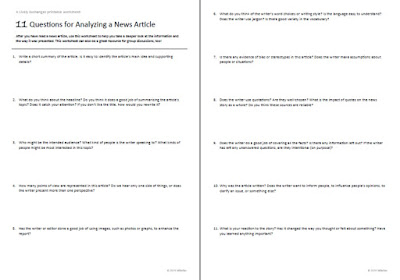
We cover a lot of exciting topics here on the Lively Exchanges blog, but there are plenty of other news stories that might pique your interest. Today's free download is a worksheet that will help you dig a little deeper when you read news stories on your own: we've got 11 questions for analyzing news articles.
Get your copy and give it a try!
Welcome to our learning community. Here you'll find news topics, questions for study and discussion, lesson suggestions, resources, and more. Have a look at the posts, find something that interests you, and join the conversation!
Saturday, July 2, 2016
Sunday, June 26, 2016
Eat like Arnold Schwarzenegger
Topic:
This article is about efforts in China to reduce the amount
of pork in people's diets.
Before reading:
General Knowledge:
- Can you find China on a map?
- What are some examples of "diet-related diseases"?
- Vocabulary: Do you know the meaning of these initialisms? Look them up if you aren't sure.
- The WHO
- USDA
- PSA
Speculate:
- An advocacy group in China is trying to convince people to eat less meat. In addition to health benefits, what might be some other advantages to reducing meat consumption?
- What challenges might the advocacy group encounter during their campaign?
Click on the embedded link below to read the article, see
photos, and watch a YouTube video on the NPR website. Word count: 632
After reading:
Review and discuss:
- Write a 3-4 sentence summary of this article. Begin your summary with "This article is about…".
- Re-read the first sentence of the article. Why might the writer have chosen to begin by identifying similarities between the US and China? How might this comparison affect the way the audience perceives China?
- Why are celebrities often chosen as spokespeople for campaigns?
- What is the importance of reducing greenhouse gas emissions? What are possible consequences of failing to reduce emissions?
- Jeremy Haft doesn't think the media campaigns will be successful. On the contrary, he thinks Chinese demand for meat will increase. If media efforts fail, what are some alternative strategies that could be used to convince people to change their meat-eating habits?
- In your opinion, what was the most interesting thing mentioned in this article? Why?
Reflect and evaluate:
- What do you think about the choice to use Arnold Schwarzenegger for this particular campaign? What are some possible reasons that he was chosen?
- In your country or culture:
- Is obesity a concern for many people? Does the government make balanced nutrition a priority?
- Is meat a big part of your local cuisine? What kinds of meat are most common?
- Are celebrities (from the US or other countries) often used to promote certain campaigns? Give an example. Do you think this strategy is effective? Explain.
- Are there any dishes that signal social status, like eating pork in China?
- Is there anything else you'd like to know about this topic? Do you have any questions that weren't answered in the article?
- What vocabulary words were new to you in this article? Make a record of what you have learned.
Beyond the page:
- Learn more about the WildAid organization: wildaid.org
- Check out some examples of different food guidelines in countries around the world: Food-based Dietary Guidelines
Also in the news:
- In the United States, celebrity endorsements of unhealthy food have made headlines recently. Take a look at this article: This Is How Much Celebrities Get Paid To Endorse Soda And Unhealthy Food
Join the conversation: add your thoughts about this article
in the comments section below. And don't forget to share this post with your
friends!
Labels:
celebrities,
China,
diet,
environment,
food,
health,
NPR
Tuesday, June 21, 2016
Bhutan's model for managing stray dogs
Topic:
Dogs have an important role in the ecosystem of Bhutan. This
article is about how the country is managing its population of strays.
Before reading:
General Knowledge:
- Can you find the country of Bhutan on a map? What do you know about it?
- What is a "stray" animal? How do these animals affect the areas where they live?
- What does it mean to spay or neuter an animal? What is the purpose of this?
Speculate:
- When the people of Bhutan tried removing all stray dogs from the streets, they noticed an unexpected negative consequence. What might that have been?
Click on the embedded link below to read the article, see
photos, and listen to or download the audio file on the PRI website. Word
count: 910
After reading:
Review and discuss:
- Write a 3-4 sentence summary of this article. Begin your summary with "This article is about…".
- What do you think about Bhutan's system of "community" pet ownership? Compare and contrast the way dogs are cared for in Bhutan with the way they are cared for in your culture.
- What effects might the Catch-Neuter-Vaccinate-Release method have on Bhutan's economy? How about on tourism? What other outcomes do you predict?
- Explain the purpose of putting a notch in a dog's left ear after it has been spayed or neutered. Why is it important to be able to recognize whether a dog has been spayed/neutered?
- In your opinion, what was the most interesting thing mentioned in this article? Why?
Reflect and evaluate:
- Twig Mowatt says, "Bhutanese people, who are largely Buddhist, believe that sentient beings should be cared for." Where you live, are there religious ideas or other beliefs that affect the way people interact with animals or the environment? Explain.
- Are there stray animals where you live? What kind? Do they have an important role in the ecosystem, like the dogs in Bhutan?
- Is there anything else you'd like to know about this topic? Do you have any questions that weren't answered in the article?
- What vocabulary words were new to you in this article? Make a record of what you have learned.
Beyond the page:
- Find out more about Humane Society International, the organization that helped Bhutan establish its program. Then, look for information about Humane Society programs where you live.
Also in the news:
Read recent news about stray animals in other parts of the
world
- India: Stray dogs, pigs a menace in Maharani Bagh
- Serbia: Call to Help! Belgrade activist sets up animal charity
- Turkey: Turkish children hide stray dogs from municipal police
Join the conversation: add your thoughts about this article
in the comments section below. Like Lively Exchanges on Facebook, and don't
forget to share this post with your friends!
Friday, June 17, 2016
Will Taiwan's new president help to create a better future for aboriginal people?
But first...
Have you sent in your photo for the Lively Exchanges Summer Photo Exhibition yet? Make sure you do! We're excited to see what you share with us. Click here for information.
All right? Now, on to today's news topic. ;)
Have you sent in your photo for the Lively Exchanges Summer Photo Exhibition yet? Make sure you do! We're excited to see what you share with us. Click here for information.
All right? Now, on to today's news topic. ;)
Topic:
This article is about native people in Taiwan, and how they are
hopeful that Taiwan's new president will have a positive influence on the way
they are treated.
Before reading:
General Knowledge:
- Can you find Taiwan on a map?
- What does 'aborigine' mean? What are some of the challenges that aboriginal people have faced in countries around the world?
Speculate:
- What kinds of improvements might the aboriginal people of Taiwan hope to achieve under a new president?
Click on the embedded link below to read the article, see
photos, and listen to or download the audio file on the NPR website. Word
count: 811
Taiwan's Aborigines Hope A New President Will Bring Better Treatment
After reading:
Review and discuss:
- Write a 3-4 sentence summary of this article. Begin your summary with "This article is about…".
- When people tell Yayut that they don't think she looks like an aborigine, how does it make her feel? Why might it make her feel this way?
- What are some possible reasons that "many younger indigenous people are unaware of their own cultural and linguistic traditions"? In other words, what factors influence how or whether these traditions are passed on?
- In addition to having more support from the government, what are some other things that must change in order to improve the way indigenous people are treated in Taiwan and in other countries?
- In your opinion, what was the most interesting thing mentioned in this article? Why?
Reflect and evaluate:
- Which indigenous groups live—or have lived—in your region or country? What do you know about them?
- What can happen in situations where governments don't protect the traditions and property of indigenous peoples? Do you know any examples of when this has happened before?
- Takao Wutao says: "Hunting is how we connect with our ancestors' wisdom about using the forest. The only way for us to receive this wisdom is to experience it in the forest." In your country or culture, how important is it to have a connection to the land? Explain.
- Is there anything else you'd like to know about this topic? Do you have any questions that weren't answered in the article?
- What vocabulary words were new to you in this article? Make a record of what you have learned.
Beyond the page:
Take a look at some of these sites with maps and other information
about indigenous peoples around the world:
- AIATSIS map of Indigenous Australia
- Indigenous Peoples (from the Food and AgricultureOrganization of the United Nations)
- Native Planet
- First Peoples' Cultural Council
- LandMark: Global Platform of Indigenous and Community Land
Join the conversation: add your thoughts about this article
in the comments section below. And don't forget to share this post with your
friends!
Thursday, June 9, 2016
Get your cameras ready!!
Today we're kicking off the first-ever Lively Exchanges Summer Photo Exhibition!
Do you like taking pictures? We'd love for you to share them with us. Whether you're an amateur or a professional, you can participate. Just download the handout with information and instructions, and get clicking! (Or let me know if you have any questions...)
Get started here:
Now start sending in those photos! The earlier, the better. ;)
Do you like taking pictures? We'd love for you to share them with us. Whether you're an amateur or a professional, you can participate. Just download the handout with information and instructions, and get clicking! (Or let me know if you have any questions...)
Get started here:
Now start sending in those photos! The earlier, the better. ;)
Students at an Iowa university learn about sustainable agriculture
Topic:
**Make sure to check the Lively Exchanges page again tomorrow for a special announcement!**
This article is about a student-run farm in Iowa.
Before reading:
General Knowledge:
- Look at a map of the US. Can you find the state of Iowa?
- What kinds of tools are used for gardening? What tasks are each of the tools used for?
- What is "sustainable agriculture"?
Speculate:
- What might be the effects of giving students the opportunity to learn by working in a garden?
Click on the embedded link below to read the article and see
photos on the NPR website. Word count: 655
After reading:
Review and discuss:
- Write a 3-4 sentence summary of this article. Begin your summary with "This article is about…".
- What might these students be learning through hands-on work in the garden that they wouldn't learn in a classroom only?
- Not all of the students who work in this garden will become farmers. Do you think that this class can benefit them even if they choose another type of career? Explain.
- Riley Madole says he'd like to continue this type of work in the future, but only a small number of other people in agronomy are also choosing sustainable farming. Why might more people prefer industrial (non-organic) farming instead?
- In your opinion, what was the most interesting thing mentioned in this article? Why?
Reflect and evaluate:
- Would you have been interested in an agronomy class like the one in this article, if it had been available to you? Explain.
- Student Heidi Englehardt says that working in the garden has given her a "passion" for physical work. What experience have you had with physical work? Do you enjoy it? Why or why not?
- Do you have a garden? What do you grow? If you don't have a garden now, what would you like to grow if you had one?
- Is there anything else you'd like to know about this topic? Do you have any questions that weren't answered in the article?
- What vocabulary words were new to you in this article? Make a record of what you have learned.
Beyond the page:
- Want to know more about sustainable agriculture? This page has a lot of information: What is sustainable agriculture?
- Take a look at this infographic on agriculture: The Global State of Agriculture
**Make sure to check the Lively Exchanges page again tomorrow for a special announcement!**
Join the conversation: add your thoughts about this article
in the comments section below. And don't forget to share this post with your
friends!
Sunday, June 5, 2016
Follow-ups: New perspectives on previous posts
Let's take a minute to revisit some of the topics we've seen
over the past few weeks. Did one of these topics interest you? Take a look at
other perspectives on the problems or situations that have been covered in
Lively Exchanges discussions.
Topic #1: Finding familiar food when you're far from home
In the original post "Familiar foods in foreign places" we read about a shop in Germany that sells British products to
expats and curious German customers alike. Now, try this article about a supermarket in LA that caters to the largest
community of Thai people outside the country of Thailand: The Family-Run Thai Market That Feeds LA's Eclectic Food Scene.
Or read this article on a place where many people might be surprised to find
products imported from Japan: For Great Japanese Cuisine And Grocers, Head To Central Ohio (Really)
"It's this remarkable place, it's a little Japanese
wonderland right here," says John Millen."
Topic #2: Universal ways of communicating
In the original post "How universal are our facial expressions?" we looked at how some facial expressions may have similar meanings across cultures. Read this article to find out about how we communicate through laughter: Ha ha HA Haha. The Sound Of Laughter Tells More Than You Think
"A hearty, belly laugh means the same thing on every
continent: joy."
![]() |
| Jonathan & Angela Scott/AWL Images RM/Getty Images |
Topic #3: Car rationing
In the original post "Smog-induced stress for Mexico City residents" we learned about how pollution troubles in Mexico City led
to a car-rationing system, which was proving to be a hassle for many of the
city's inhabitants. Here is a link to a radio report (with a
transcript!) about the results of a similar attempt to reduce the number of
cars on the road in India: Car Rationing Experiment Backfires In Polluted New Delhi
"I think many people would be surprised to hear
somebody who sells cars for a living saying cars are part of the problem."
***
Talk about these topics with others, or write about your
reflections in a notebook. Do these new articles change the way you thought
about anything? How do they help you understand the topic better? Share your
thoughts in the comments section below, and don't forget to like the Lively
Exchanges page on Facebook!
Subscribe to:
Posts (Atom)